monoruby has its own garbage collector: a non-moving, single-threaded, stop-the-world, generational mark-and-sweep collector, modeled on CRuby’s RGenGC. This page is an overview; the full design document is doc/gc.md, and the implementation lives in monoruby/src/alloc.rs.
Heap layout
- All heap objects (
RValue) are exactly 64 bytes. Memory comes from a single 2 GB virtual arena reserved up front, carved into 256 KB pages of 4032 cells each. - Mark bits and old bits are stored outside the object cells, as per-page bitmaps. A pointer’s page is found with a single address mask, so bitmap lookup is O(1).
- Objects never move, so raw
*const RValuepointers stay valid across collections. - Allocation pops from a free list when possible, otherwise bump-allocates in the current page. The JIT inlines this free-list fast path directly into compiled code.
Generational collection
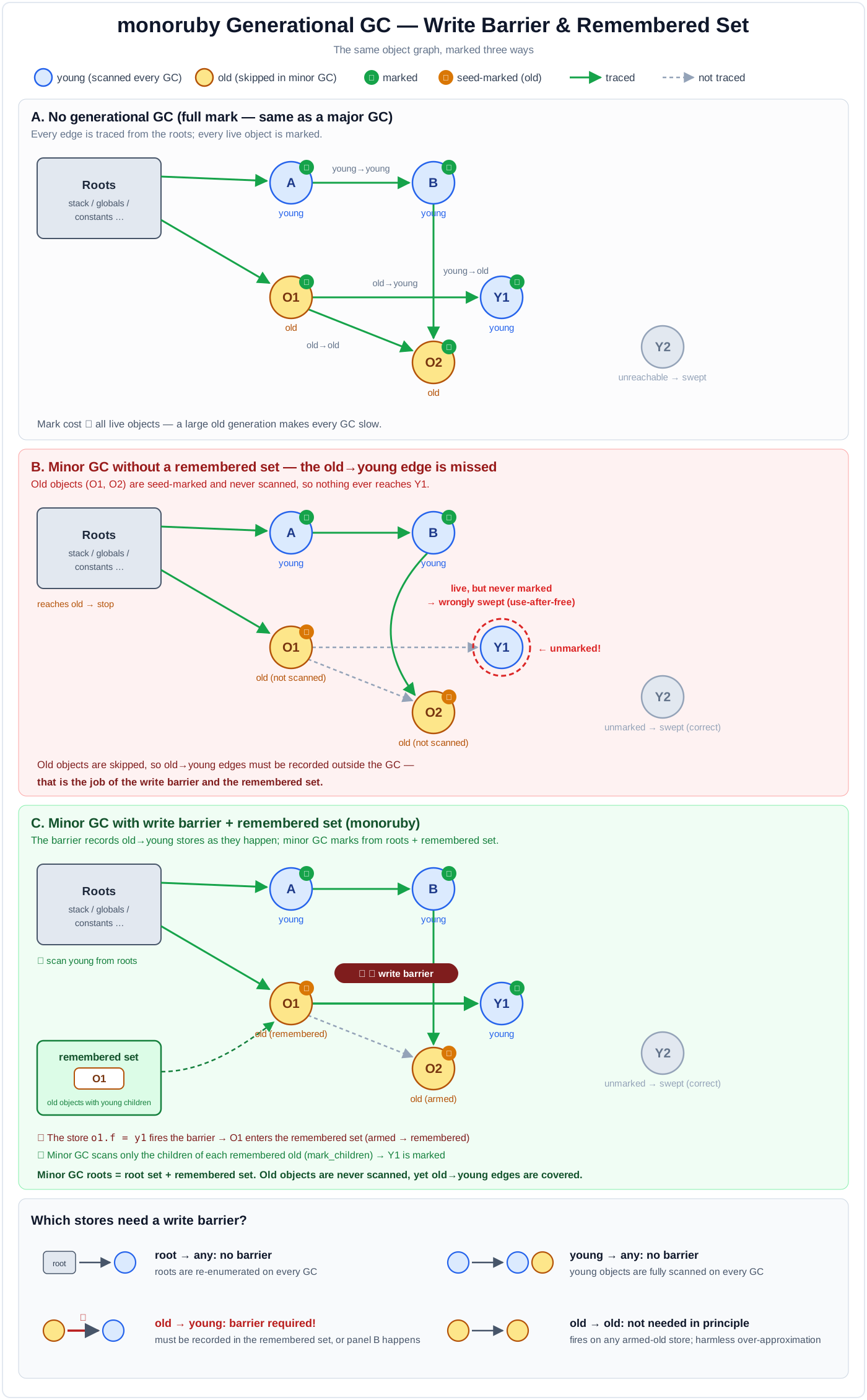
Minor collections trace only young objects; old objects are assumed live and their mark bits are seeded from the old bitmap.
- Objects of promotable types (Object, String, Array, Hash, Bignum, Float, Struct) age by one on each minor GC they survive; at age 3 they are promoted to the old generation.
- Write barrier: when a reference is stored into an old object, a single header-bit test decides whether the object must enter the remembered set, whose old→young edges are traced during minor GCs. The JIT emits the barrier inline; bulk operations (
Array#concat, …) use a bulk variant. - A major (full) collection runs when the old-object count crosses an adaptive threshold or after 64 consecutive minors; it clears all generation state and retraces everything.
GC.startalways forces a major.
The write-barrier / remembered-set interaction (including why a minor GC without the barrier would sweep live objects) is illustrated in doc/gc_write_barrier.svg.
GC triggers and safepoints
Collections are requested by setting a single per-thread alloc_flag, and performed only at safepoints:
- Allocation pressure — every ~8 filled pages trips the flag.
- malloc pressure — a custom
#[global_allocator]tracks off-heap allocation (String/Array backing stores etc.) and requests a GC when it outgrows an adaptive threshold, so heavy malloc traffic can’t outrun the heap-cell trigger. - Explicit —
GC.start.
Safepoint polls (compare alloc_flag; conditionally call gc) are emitted at callee entry and loop back-edges in both the VM tier and JIT code. The same poll also drives green-thread preemption and pending-signal delivery (see Threads and Fibers). Rooting is precise: roots are explicitly enumerated — the executor’s frame chain, temporary-value stack, the green-thread scheduler’s thread registry, pending exceptions, and global state — never conservatively scanned off the machine stack; JIT code spills live registers before a safepoint call.
Controlling the GC
| Control | Effect |
|---|---|
GC.start | Force a full (major) collection |
GC.enable / GC.disable | Toggle collection at runtime |
--no-gc CLI flag | Disable GC for the process |
GC.count / GC.stat | Collection counters / CRuby-compatible stats |
Debugging Cargo features: gc-log (stats at exit), gc-debug (assertions), gc-stress (force a collection at every safepoint, unconditionally — used by bin/test’s nextest phase on x86-64 CI), gc-verify (independent re-mark verification after each minor GC).
Further reading
doc/gc.md— full design document (heap layout, bitmaps, aging/promotion, remembered-set self-cleaning, heap-escaped frame reclamation)doc/safepoint.md— the safepoint / poll-flag mechanism shared by GC, preemption, and signals